

As the Cannes film festival comes to a close, I thought I would revisit a piece I wrote for Film Independent in 2014 after the debut of my film IT FOLLOWS. When I wrote the piece, I was feeling as though my voice as a producer did not matter and assumed no one would read it (I didn’t know it then, but this piece planted the first seed for creating Dear Producer). I used the assignment as a cathartic experience and spoke candidly and with an open heart. To my surprise, people did read the piece and producers began reaching out saying that they too felt invisible and shared their struggles of the producer’s place (or lack of place) in our industry.
What I wrote struck a cord and 12 years later, the piece still comes up in conversations. Unfortunately, producers continue to go unrecognized and unpaid for their work and their contributions to the industry and culture. However, strides have been made and our community has fortified. I launched Dear Producer in 2018 and led an attempt to create a union for producers during the pandemic. The Documentary Producers Alliance formed in 2016 to advocate and set best practices on behalf of documentary producers. And most recently in 2023, Producers United formed to organize around activations designed to make lasting, positive systemic change for Career Producers. And we can’t forget about the European Producers Club who has been advocating on our behalf since 1993.
I am continually amazed by producers. Whether it is my partners on my own films, my producer friends who I cheer for from the sidelines, or all the emerging producers I’ve taught over the years. You truly are remarkable humans who make this world a better place by championing original, compelling, and essential storytelling. The industry may not always see you, but I do.
First Published via Film Independent June 2, 2014 by Rebecca Green
Film festivals are filmmaker-centric and they honor and recognize the creative. The implication is that producers are not part of that creative magic. Yet I would argue that we are the ones who hold the wands.
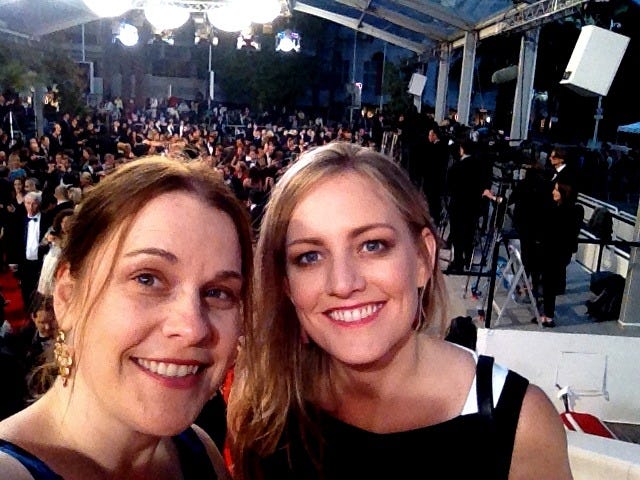
When asked by Film Independent to write about my experience at Cannes, I thought about describing how amazing it was to be part of such a prestigious festival filled with A-list celebrities and red carpets, or about dancing my stress out to Robin Thicke live at the Gothe nightclub, or about how I got goosebumps watching MOMMY at the Palais and was moved to tears during its standing ovation. While all of that happened, you can read about that sort of experience anywhere. The more honest approach to this piece is to talk about how I experienced the festival as a producer.
It was a surreal experience. One where during the course of 10 days, I felt like Marty McFly in BACK TO THE FUTURE, fading from a photograph as the festival progressed. I slowly began to realize that producers are invisible, sometimes in general, but most specifically on the festival circuit. With a festival as beautifully curated as Cannes, I did not expect this sort of feeling.
As producers, we know that it is not about us. That if we’ve done our jobs right, the spotlight is on the filmmaker, the talent, and a fantastic film. However, what producer doesn’t want to be acknowledged for their work?
Upon arriving in Cannes (still in disbelief that we had a film playing at the festival), my producing partner (Laura Smith) and I went to pick up our credentials, which came with the catalog for Critics’ Week. We quickly turned to our film’s page, excited to see it in print, but were met by the disappointment that no producers were credited in the printed catalog (or online). None. Not just for our film, but for all films playing at the festival. Credits included director, screenplay, cinematography, editing, production design, sound design, music, and cast. I had put years of my life into this film and those who had spent as little as six weeks received recognition.
Perhaps I was extra sensitive because my film, IT FOLLOWS, was an unusually challenging project for me, both mentally and emotionally. My mother had died just a few months before production began and digging deep in to the trenches of filmmaking was the last thing I was prepared for. However, I did what all producers do. I put the film first and pushed forward.
As I faded from view in Cannes, I wondered what the future of independent cinema would look like without producers? Would we simply be replaced by financiers, agents or our filmmakers? What if producers collectively said this is too hard, there is no money, and there is also no recognition, and it’s just not worth it anymore. If producers were obsolete, would anyone notice?
As the festival continued, Laura and I found ways to shake off the invisibility cloaks. We danced and mingled and carried on amidst the excitement of the festival. We were greeted by people who had seen and loved the film and each day woke up to reviews filled with praise. After all the blood, sweat, and tears we had poured into the film, it was a thrill to see that it was being received so positively and that our filmmaker was having his moment in the sun.
Yet despite our efforts to not let the lack of inclusion dampen our spirits, that invisibility kept rising up. In attending our film’s first Q&A, which was out of town, the festival provided a car to get the film team to the theater. However, we came to learn that the ‘film team’ did not encompass the producers and we would have to catch a cab on our own dime. Soon we began to feel like the third wheel tagging along on a date to the prom. We were an essential cog of the movie-making machine during production and getting the film ready to screen, which was a feat in itself, yet the message we kept getting was that our contributions were somewhat less valuable.
Ultimately, producers are not looking for fame or attention, rather we are simply looking for a nod, an acknowledgement that we have made a contribution to cinema. This type of recognition fills us up so that after we have been drained by the trials of making a film, we can have the strength and determination to begin another.
Small gestures by festivals, such as including our earned credits in print, curating organized events so that we can meet our fellow producers, and encouraging us to have our own creative voice, would forge a stronger more cohesive community and in turn, a more sustainable industry.
So why am I a producer? This is a question I’m still trying to answer. I can say that it brings me great joy to be the person working side by side with a filmmaker, taking the seed of an idea and turning it into a moving image in which others watching will respond with joy, heartbreak, or in the case of IT FOLLOWS, terror.
Perhaps the existential air of France was affecting me - I wondered why we do it, even in the void of recognition. And we will continue to. Perhaps like the often-ignored middle child, producers continue to make movies with the hopes of being seen.
So, what if producers were obsolete? The funny thing is, because we are producers, we would never let that happen.
Thanks for this excellent post, Rebecca. It's distressing how little has changed since your first post on the subject in 2014. I have a film in competition in Tribeca, and it turns out that all invitations to festival events go to the "Director/Creators" only. In 2026. Even after all of the industry conscious raising, here we are -- still virtually invisible. Tribeca does at least list producers on the film's page, which is an important step forward. Your persistent voice and your work in the field are greatly appreciated by me and by producers everywhere.
Such an important post. I felt the same when a major festival for our world premiere called the producers, "Guests of the Filmmaker." I was shocked at how this festival viewed my hard work on the film. Now, I believe that I am a filmmaker. I spend years developing a script and I mean spending countless hours reading and crafting notes, time on Zooms walking through those notes, reading changes to a point where the script is deemed ready for production etc etc. And then I go out and help find the means to make the film, sourcing financing and setting up fiscal sponsorships and crowdfunding campaigns and help with applying for grants. From there, I oversee all hiring of cast and crew, consult on the every aspect of the creative every single day, and I manage all aspects of production, marketing and release on top of being a managing member of the LLC. I'd say that makes me every bit a filmmaker as a director. I agree the director should absolutely have her/his moment in the sun but it's a marriage between a director and a producer. Directors know this. It's the festivals that need to realize and recognize that too. Thanks for all you do Rebecca!