

The 2026 Sundance Film Festival Producers Celebration, presented by Amazon MGM Studios, took place on Sunday, January 25, 2026, where producers of films featured in the festival program, Producers Lab & Fellowship alumni, and industry supporters came together for the Sundance Institute | Amazon MGM Studios Producers Awards and a keynote address by Shane Boris, producer of Fire of Love and Navalny; his latest projects premiering at the 2026 Sundance Film Festival included Time and Water and The AI Doc: Or How I Became an Apocaloptimist.
The winners of the Sundance Institute | Amazon MGM Studios Producers Awards, which included two $10,000 grants — one for fiction and the other for nonfiction — were producers Apoorva Guru Charan (Take Me Home, U.S. Dramatic, Waldo Salt Screenwriting Award) and Dawne Langford (Who Killed Alex Odeh?, U.S. Documentary Special Jury Award for Journalistic Excellence). Apoorva and Dawne are 2022 Sundance Institute Producers Labs & Fellowship alumni.
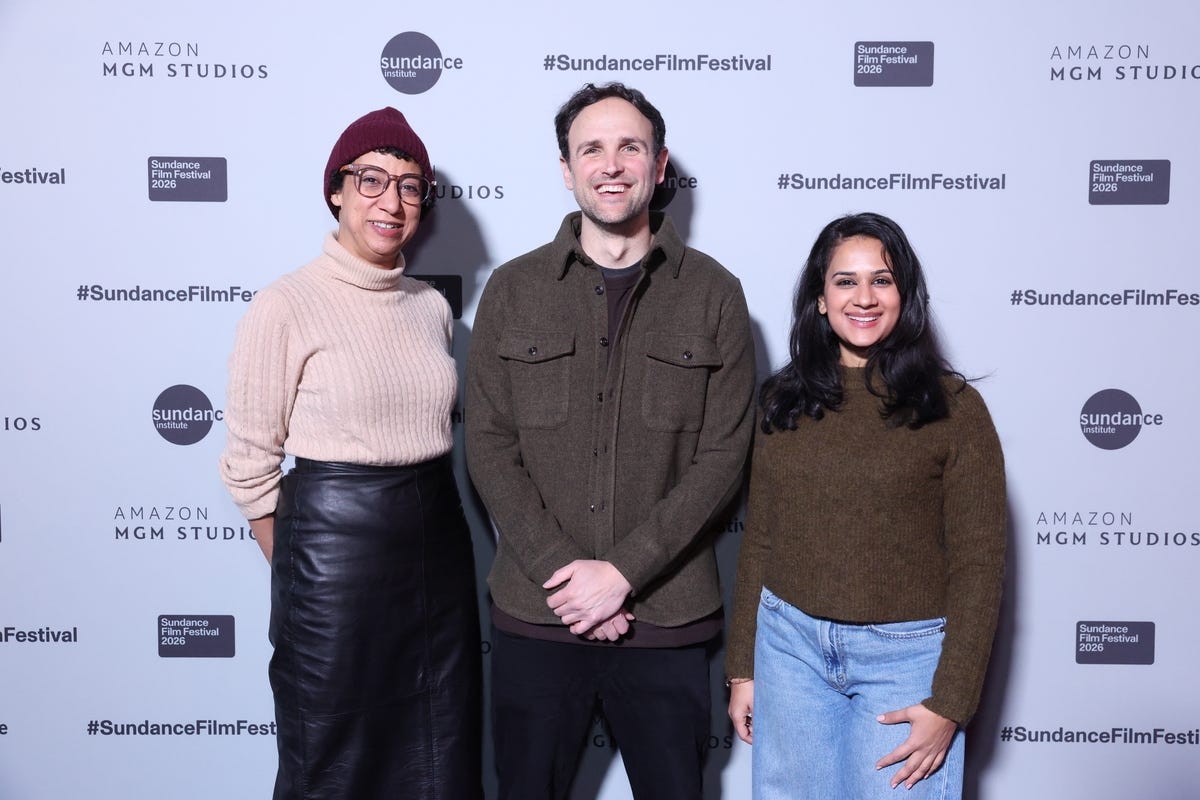
Before Shane gave his keynote, Kristin Feeley, Sundance Institute Director, Documentary Film and Artist Programs, had this to say about his exemplary work….
“2026 Sundance Film Festival Producers Celebration Keynote Shane Boris is a consummate creative producer and champion of visionary artists making adventurous, creative nonfiction. His body of work is political without being didactic, wildly creative without feeling inaccessible, imaginative yet rooted in essential truths. Shane is a fierce protector of the beating heart of the creative process and so deeply humble that he would never tell you that he has the rare distinction of being nominated for an Oscar with two films in the same year, Sara Dosa’s Fire of Love and Daniel Roher’s Navalny. He returned to the Sundance Film Festival this year with two films reuniting him with those collaborators,Time and Water and The AI Doc: Or How I Became an Apocaloptimist. He has produced 13 features since his first feature, Michal Marczak’s All These Sleepless Nights, premiered at Sundance ten years ago. Shane has an intense curiosity and restlessness, which employs choosing projects and collaborators. The connective tissue between the work is Shane’s empathy and boundless compassion for his collaborators. In this chaotic and uncertain moment, these were some of the qualities we felt the field and the world could use more of, and why we asked him to deliver the 2026 Producers Celebration Keynote.”
Producers Celebration Keynote Address by Shane Boris
I feel profoundly humbled to be here among all of you incredible producers who are experiencing your first Sundance, as well as those of you whose work has for years expanded the craft of filmmaking. And especially at this last Sundance in Park City. I mean this sincerely, I wouldn’t have had a career as a producer without Kristin Feeley or the Sundance Institute. You have transformed the prospects and trajectories of countless films, you have redefined what independent filmmaking means, and you have enriched the lives of so many of us filmmakers. From the bottom of my heart, and beyond anything words could ever express, thank you. Thank you Shira, Kristin, Michelle, Maria, Andrea, Tabitha, John, Enrique, Paola, Hajnal, and Amazon MGM Studios for supporting this event and the Sundance Producers Program.
I’ve recently lost my peace. What I mean by that is, for many years, both by cultivating a practice and outrunning some of my issues, I mostly felt a wholeness of my identity, a throughline to the narrative of my life and how I related to the world around me.
It went something like this: growing up I wasn’t sure what I had to offer. I sensed that I could easily connect with others and I loved listening to them. I would scan for creative sparks with everyone I met. When something sparked, I would see if maybe we could kindle a little flame, and from there maybe turn that into a fire in the form of a moment, a lasting friendship, or a creative collaboration. These collaborations yielded all kinds of projects: songs, books, companies, plays. I loved doing this and was passionate about it. But I didn’t know if there was a career path for this kind of thing.
So I did a series of unconventional moves to try and find out if there was a more conventional path. Nothing really stuck and in between these failed attempts at fitting in what I remained passionate about was this life of an itinerant listener. I would travel with two passports and 8 sets of friends’ house keys in my backpack, staying with anyone that I shared a spark with and the need for someone to bounce kernels of ideas off of, identify threads that should be followed, and think through ways to actualize their visions. I owe so much to these friends.
And then I did this for a filmmaker. And then another. And then another. And then people started calling me a producer.
A meaningful, coherent professional life seemingly emerged. I worked with geniuses on films that I believed in. I told myself I was serving important, singular stories that needed to be told. I felt largely fulfilled in feeling like I was serving these extraordinary people’s visions and I was exhilarated when some of their obsession-dust fell on me. I also benefited from some of the perks of the trade: I could finally tell my parents there was a word for what I did; I got to meet amazing people in amazing places; and I fell in love with camaraderie of collaboration and the pure, unadulterated joy of making an impossible thing that was once just a seed of an idea come to life and have a chance of meaning something to someone.
But as I professionalized, the narrative throughline of my work as a person and as a producer ran up against a paradox, one that I am very much still trying to untangle: How are we producers, who are expected to be exceptionally pragmatic, who have exceedingly demanding jobs, who are tasked with planning and executing fully formed plans in circumstances with so many variables–how do we also continue to dream and live in accordance with our ideals?
How are we supposed to balance working backwards always from “what does this film need in order to find and become its truest self?”–an impossibly idealistic question to even think about asking–with “how can I help get the film what it needs in order to become that?”–a question that requires the most practical and pragmatic considerations?
These questions have only become more urgent. The world is clearly in crisis. What will happen with our industry is impossible to predict. We’re living in a time of great uncertainty, one in which the old rules don’t apply, and yet the new rules haven’t been written.
Both of the films I produced at this year’s Festival are in some ways about the possible foreclosure of a future I, like many of us, had previously imagined. In TIME AND WATER it’s the consequences of the climate crisis on our interconnected water systems and our sense of time itself. In THE AI DOC: OR HOW I BECAME AN APOCALOPTIMIST it’s the risks of racing to develop and deploy the potentially most transformative technology ever under the worst possible incentives.
But beyond seeing this uncertainty in the world, and even more than exploring it in these films, I am feeling it internally.
Here is what I am grappling with: how are we supposed to produce movies that come from our soul in this moment when all of the stakes feel so high? What does good producing mean right now? What does good living look like?
I don’t have the answers.
At the moment, something that is getting me through is the company I keep. I have collaborated with some of the best producers in the world. And this doesn’t even include all of the incredible executive producers I have worked with as well. Not only have they helped me navigate extremely challenging circumstances in order to turn ideals into reals, they have made space for me to have a chance to give projects something of value. I can’t thank them enough.
One thing that I’ve always loved in documentary and really all art-making and storytelling at its finest, but also something I am experiencing quite acutely now, is the practice of living inside of the unknown. Having just finished these last two films, one thing I can say about the filmmaking process is that we will undoubtedly experience not knowing what to do or where to go, and we will have to figure it out. We will be forced to ask ourselves time and time again how to live spontaneously and improvisationally in relationship with the mystery. And after we respond once, however imperfectly, to the unknown with grace, we will hopefully be able to do it again, and again until we gain a confidence that we’ll be able to cross the river by feeling for stones.
And also, perhaps our job is not to succeed. Maybe our job is to strive, and never stop striving.
One last thing I want to share with you, as we are all celebrating being here – and how rare and beautiful it is to have found each other in this increasingly disconnected world – is also a word of encouragement for the part of you which is reeling from how hard it was to get here. (I am saying this to you and I am also telling it to myself.) Here we are, surrounded by each other, and in this moment we don’t have to be daunted by the suffering of not reaching our ideals, in our art or in our life.
I am going to keep striving for the ideal even though I will never reach it in my living or in my producing. Part of this will mean helping the films I work on and care deeply about get financed, made, marketed, seen. The other part is making sure these films never lose sight of their ideal, always striving to become the soil in which something wondrous can grow.
I so appreciate the generosity in your speech, Shane, in telling the story of how you organically came to producing, and sharing the uncertainty you feel personally right now. Thank you for sharing it with us here on Substack!
Thanks for writing this. The ability to easily connect with others and listen... loving the camaraderie of collaboration...getting to meet amazing people in amazing places..I really related. You helped put into words what I know about myself and what drew me to this work.