

TONY YANG: Spirit Awards Producers Award Winner
By Rebecca Green

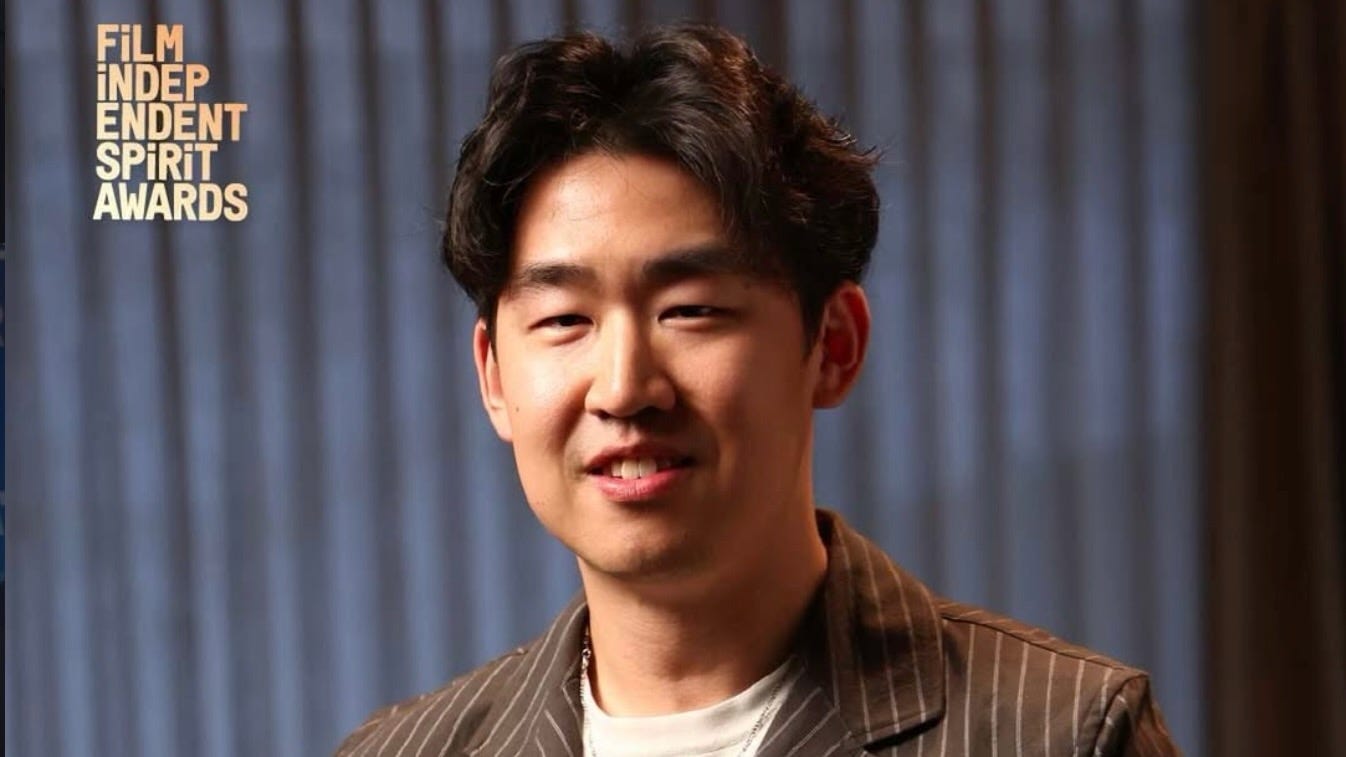
As the winner of the Film Independent Spirit Award Producers Award, presented by Producers United, and with six Spirit Award nominations between his two films, BLUE SUN PALACE and LUCKY LU, producer Tony Yang is on a winning streak. Sitting down to chat with Dear Producer, Tony reflects on his unconventional path from pre-med to producing, the value of his film school experience, and his passion for international storytelling.
I’m in the middle of conducting admissions interviews for the AFI Producing program so I’ll start with the question I ask of all the applicants: What does the role of the producer mean to you?
I’ve had a core guiding philosophy for producing for a while now; my job as a producer is to provide the best possible environment for everyone around me to succeed. I very much see it as a leadership role, but I also see it as a role of service. It’s my responsibility to make sure that the director, the DP, the production designer, the talent, every single department, can do their best job and be the most creative. I’ve always seen a producer as a jack of all trades. You have to understand every aspect of every department, everything that goes into making a movie, because you are the person that people come to with questions. The director is the one we’re all following creatively, but in order to make things happen, you have to have a great producer. You have to understand every single cog in the machine to make a movie, and be willing to really get your hands dirty.
What do you love about producing?
I was pre-med in undergrad for three years. Both my parents are oncologists and cancer researchers. For a very long time I thought I was going to go into medicine, I always found it fascinating, but it wasn’t something that I loved. I found it so isolating. I remember being at an internship junior year and thinking, “This is not for me.”
When I switched over to film, I immediately fell in love with being around creative people, with the collaboration. The people that work in the film industry are just so rare and special. The unique energy and experience of being on set with such a wonderfully creative group of individuals is unlike anything else in the world. When I’m on set, I love making sure that things are going smoothly. I know that so many creatives are just not wired the way producers are. They don’t think about budgets, scheduling, and all the logistical things. But I do, and I know I can help make their lives easier, make filmmaking and art easier. My personality and how my brain works can take care of that business side, that logistical side of moviemaking. But I also love storytelling. I am so fulfilled when I see the creative vision come to life and know that I contribute to that. There are so many stories I’m drawn to. At the end of the day, I know just how hard everyone works on independent films. These chances for filmmakers to make their movies are so rare these days, and knowing that, I am driven to work twice as hard so everybody else has that much easier of a time on set to perform to the best of their ability. I am truly so grateful for every opportunity to continue to do what I love, and to do it with people I cherish.
That’s a pretty big jump from medicine to film school. What was pulling you to filmmaking?
Growing up, my entire family actually loved movies and going to the movie theater all the time. There’s something about movies that energizes me, that brings out my emotions in untold ways and come alive. There’s a repression in Asian culture where you don’t talk about feelings, but going to the movies allowed me to tap into my emotions in an accepted way. When I was thinking about what I actually want to study that was going to make me happy, that is going to allow me to experience life to the fullest, I knew it was filmmaking, because of how movies make me feel. From there, I thought about what I could actually do well within the industry, and with the way I’m wired, producing made the most sense.
How did your parents feel about the switch?
They could tell I was unhappy studying medicine and it wasn’t an easy conversation. But as soon as I said producers take care of the business side of things—literally the second I said “business”—they were like, “Okay, got it.” I think if I said I want to be a director or an actor, they would have pushed back, but they understood producers raise money and that made it alright in their minds.
You went to Columbia for your master’s degree and there’s about a five-year window on your IMDb from 2017 to BLUE SUN PALACE where you produced so many short films. Could you talk about that period of your life?
I moved to New York in 2016 and started out as a production assistant on different sets trying to get as much experience as I could. But I knew I wanted to learn about story, and that’s where Columbia’s program really thrives. I started my master’s in creative producing in 2017. What’s really great about the Columbia program is that every single student—producing students, writing students, and directing students—have a shared curriculum in the first year. I took directing, I took screenwriting, I took directing actors. They want to give everyone the same fundamental baseline. We all had the same requirements: all 75 students in the first year have to direct, produce, and write a short film twice. We did a five-minute short film in the first semester, then an eight-to-twelve-minute short film in the second semester. That’s 150 short films being made. I was on at least 20 different sets and not just as a producer. I was a DP, a first AD, a gaffer, a grip, a first AC. I wanted to expand my horizons in all aspects of filmmaking because film school offers a safe environment for you to fail. One of my professors really drilled into our heads: this is the time when you can focus on your craft. I took that to heart. I wanted to be on as many short films as possible to gain experience, but also to meet directors and other collaborators.
Constance (Connie) Tsang, who directed BLUE SUN PALACE, was one of my first collaborators. I was her first AC on her first five-minute short film at Columbia, and then I was the DP on every single one of her directing exercises before also producing for her. I found so many different collaborators that I still work with. There are producers in China who helped me on BLUE SUN PALACE. There’s a producer in London I go to when I want to do something in Europe. I’m talking to a friend from my class about potentially shooting in Spain and she’s going to do a budget for us. I saw Columbia as one of the greatest opportunities to get experience and meet people. That’s why there are so many shorts on my IMDb from 2017 to 2023. Even after I graduated in 2020, I came back and worked on so many thesis films for directors.
I realized something when I was working on so many shorts: these ideas and the creativity for so many of the directors lives in them, it sits with them. There’s a part of me that feels so protective of all the directors and filmmakers putting so much of their heart and energy into their projects. I will work twice as hard so everyone’s jobs can be a little bit easier. I’m so lucky to do what I do, and I want to spend every single minute making sure that everyone on my set is taken care of, that they feel like they can do their best job, and that this creative baby they have is coming into the world as protected and as loved as possible.
How did BLUE SUN PALACE come about? When did you get involved?
Connie had written the script in 2019, and then the pandemic happened, so she focused on developing the script. I’d say 2022 is when we really started to focus on trying to make it happen. We continued to develop the story and eventually got into the Tribeca Creators Market.
What really started pushing us forward was talking about talent. BLUE SUN PALACE is entirely in Mandarin and Connie’s first feature, which made it a hard sell to investors without talent attached. We needed to get someone on board. Connie’s dream actor for this role was Lee Kang-Sheng, so we went to multiple agencies for help, but no one knew how to contact him because he’s primarily based in Asia. I reached out to my friend who I went to Columbia with who was working in China and asked if she knew how to get to him. Coincidentally, she had just made a short film with him. My friend said that the easiest way to reach Kang-Sheng was to just have Connie DM him on Instagram and he will respond. So, Connie messaged him on Instagram and sent him our thesis film that we did together. He responded, intrigued, and gave us his WeChat and we started talking. We had the script translated for him and he said he really liked it and likes working with first-time feature filmmakers. He said if we could find a window when he is available, he would do it.
Once he was attached, it suddenly became a very legitimate project in the eyes of Asian investors—Hong Kong, Taiwan, China, even Singapore. Eventually, we found a group of Hong Kong investors that financed the film fully. From there, we were able to get the other talent attached because they wanted to work with Lee Kang-Sheng. He was the first big stepping stone into making that feature.
Once we got him attached and got financed, I found my other producers, Sally Sujin Oh and Eli Raskin, and from there it was just a regular filmmaking process of figuring out pre-production, production, when to shoot, and hiring the right people. What was really cool is I got to hire a lot of the people I made short films with.
When did Lucky Lu start? Was there overlap?
There was definitely overlap. During that period between 2021 and 2023 when I was doing short after short, I produced a short called SAME OLD with the director of LUCKY LU, Lloyd Lee Choi. In 2021, we made SAME OLD, which was one the main inspirations for LUCKY LU. It was basically just me, Lloyd, DP Norm Li, an AC, a sound guy, and the actors running around New York City. I was also the first AD. Norm was changing film on top of garbage cans. Somehow miraculously, we got into Cannes in 2022 and that was the short that inspired the feature. While I was trying to finance and package BLUE SUN PALACE, Lloyd was developing the script for the feature version of LUCKY LU.
There are a lot of credited producers on LUCKY LU. How did you amass and manage the producing team?
When we premiered at Cannes in 2022, Lloyd immediately got signed by an agent at WME, and that agent then sent the short to Ron Najor and Asher Goldstein at Destin Daniel Cretton’s company, Hisako. The two of them showed it to Destin, and all of them loved it. The project was in development with them for the first couple years. Jeyun Munford, another partner at Hisako, joined Destin’s company shortly afterward and also became a producer on the film. So that was the core producing team initially: Destin, Asher, Ron, Jeyun, and myself. Destin had been long time friends with Nina Yang Bongiovi, and he told her that she had to meet Lloyd and read the script. Once she met him, she fell in love with the story, also boarded the project, and her involvement really kickstarted the financing.
Nina and Destin helped make an introduction to our lead actor in LUCKY LU, Chang Chen, who is an absolute legend in Asia. He’s pretty much Matt Damon over there. His manager made us have three meetings with her before she ever let us talk to him because she wanted to make sure we were legitimate. Then Lloyd flew to Taiwan for the Sundance Asia festival and met Chang Chen for a six hour dinner. The timing worked out well because Chen told us he would not have said yes to the project five years ago, but now his daughter is the same age as the daughter in the script. Once he was on board, we became fully financed because Taiwanese investors want to do anything he’s in.
I will admit that I initially felt a little bit like an outsider on the producing team. Just a few years prior to the production of LUCKY LU, I was watching the films the rest of the producing team made while sitting in class at Columbia. So, I really felt a sense of responsibility to prove myself and prove that I could keep up with such experienced producers. I felt like all the paperwork, all the emails, everything that came through communication wise, and everything that was on the ground had to be taken care of by me. I quickly learned however, that every other producer on the team wanted to be as involved and as helpful as possible. Even though they all had so many other movies on their plate, they made it clear that LUCKY LU was their priority and that I shouldn’t try to shoulder every producing burden. It was then that I finally felt like I was a peer and equal to all these other incredible career producers. Every producing team is unique, and it can take time to find a comfortable groove of working together, but the team understood how to divide and conquer.
What was the distribution path for BLUE SUN PALACE?
We made BLUE SUN PALACE for just under a million net. We didn’t have a sales agent until we got into Cannes, and then WME signed on and Charades became our international sales agent. They pushed as much as they could out of Cannes, but the appetite for a foreign language first-time feature in the US is very small. That’s just the market, even in a healthy economy.
We ended up working with Dekanalog, who have been wonderful. In their initial offer, Dekanalog’s commitment was limited to the major cities and covered a relatively small number of screens, which was truly the best they could safely promise. Other offers were similar, but it was clear Dekanalog cared the most about the film, and so we partnered with them. However, Dekanalog is a small company, they can only do so much, so as producers, we also put in the work to make sure we had a strong turnout. This is a film about immigrants in a foreign language that so many people in New York and LA can relate to, so we reached out to pretty much every AAPI organization that we knew to help us promote the film.
We premiered at Metrograph and were originally programmed for just one week and we sold out every single screening through word of mouth, social media, and community support. We were extended for another week which sold out again and then had a third and fourth week because the film continued to perform well. The same happened in Los Angeles. It was originally going to be one theater, then we sold out the first week and kept selling out. We expanded to two more theaters. We far exceeded that initial estimate of only 10 cities.
It was a team effort between Dekanalog and the film team putting in the time, reaching out and pushing social media. As much as we would have liked to hand off the film to a distributor and move on to the next project, on these indie films, you have to take things into your own hands to ensure success.
What lessons did you learn on these two films that you’re taking with you into your next projects?
As much as I hate to admit it, one of the biggest lessons learned is that as much as I want to just focus on art and the creativity of it all, every single filmmaker these days has to think about their audience. They have to write their stories, especially their first features, to consider: Who am I writing this for? Is there an audience for this?
As beautiful as BLUE SUN PALACE and LUCKY LU are, I think we overestimated the audience in the US. To get your films made, you have to think about fitting into a specific genre. You can’t balance 10 different genres. A professor once told me: your personal story is not interesting unless people can relate to it and can actually take something away. That stuck with me. On future projects, I really have to consider that the attention economy of the entire world is divided between so many different things. The projects we put out there have to be that much better, that much more specific, that much more cognizant of their audience.
I’ve also learned that I have to be so much more selective with my time. That’s something every producer eventually learns: your time is so valuable. You can’t take it all on at once. You are one singular person. There are so many projects I would love to be on the ground for this year, but I have to focus on the projects that mean something to me, with directors I believe in completely. I can’t jump on every short that excites me anymore. I can’t as easily join a feature film and be a co-producer or a line producer because that takes time away from the projects where I am one of the lead producers. That’s probably one of the biggest lessons.
Producers have a habit of saying they’re “helping” a project and when I hear that, I remind producers that they’re not helping, they are producing. They are filling an actual job with a real function.
There was a recent clip I saw where Ethan Hawke was talking about Philip Seymour Hoffman and Robin Williams and he explains how everything magical you saw them put up on the screen is not free. The industry assumes that everything producers get up on the screen is “helping” but there wouldn’t be a film without the labor of a producer. We are putting just as much of ourselves into everything that we touch. The idea that “I’m helping out” needs to be demolished. Whether I’m producing for you, co-producing, associate producing, whatever the role, I’m putting so much of my time and energy and skills into your project. Even if it doesn’t show up in a tangible way on screen like costume design or cinematography work, it’s still so much work.
A lot of people still ask, “What does a producer do?” It’s everything that you don’t necessarily see. What I love about the filmmakers I’m working with is they love producers, they appreciate producers. I’m still getting into the bigger industry as a whole, and I don’t know if that’s true across the board.
Producing is a real job, but it is still grossly underpaid. How are you sustaining a living?
With BLUE SUN PALACE we barely paid ourselves. On LUCKY LU, I came in acknowledging I was the youngest producer on the team and had an ‘I’ll take what I can get’ attitude in terms of pay, but Nina insisted that we all got paid equally. I really appreciated this. It was a substantial paycheck compared to anything else I had done in the past.
I also make a living by working on commercials and as a UPM. As a producer, you have a very transferable skill set to every production. I look back at Columbia and I’m so thankful I was on set all the time and did so many different things. I know how sets run and can fill many positions and have options.
You were on Variety’s 10 Producers to Watch list in 2025 and nominated for the Film Independent Spirit Awards Producers Award - how are you using this moment to boost your career?
The award is a sign of legitimacy that helps open doors. I take as many meetings as possible with whoever will meet with me. You never know in this industry who’s going to help you. If someone wants to send me a script or a deck or introduce me to an interesting filmmaker, I always say yes. I’m going to give you my time for at least a meeting so that we get to know each other. There are agents who would have never reached out to me before these awards, but now we’re acquainted. Now they know who I am. We’ve had a meeting. If I reach out to six months from now asking about one of their clients, they can’t pretend we’ve never met. There’s a face to the email now. I think that’s one of the biggest things in this industry: providing a face to an email. I want to show you who I am, that I’m authentic. If I come to you, I’m not coming for a free favor. I’m here to help you, and you’re here to help me. We can do business together.
With all the doom and gloom headlines, what is something you’re looking forward to?
I’m excited about the variety of different films that are being exposed to audiences these days. There are so many people you can talk to about amazing foreign language films like NO OTHER CHOICE or THE SECRET AGENT and they’ve actually seen it. I don’t know if even 10 years ago the general audience would have seen a single international feature film. The projects I work on and the filmmakers I work with have an international element. We’re reaching audiences that have taste and want to see so many different types of films. I know that space can be harder to break into, but I am excited about the future knowing projects like these will get made. I do think there will be a lot more variety and diversity in terms of the types of films that audiences will be exposed to. Their taste will change, and that will continue to grow and blossom. With the expansion of filmmakers on the international scene, that’s something to be excited about, for sure.
This was such an excellent read. Thank you Rebecca and Tony!